Hindu Wedding Card Format — Complete Guide with Examples (2026)
A Hindu wedding invitation is not just a card — it is a sacred announcement. It begins with the divine, honours the elders, and calls the community to witness a union blessed by centuries of tradition. Whether you follow a North Indian, South Indian, or regional format, the structure of a Hindu wedding card has timeless elements every invitation should include.
This guide breaks down the complete Hindu wedding card format with real examples, regional variations, and practical tips for creating digital invitations in 2026.
The Standard Hindu Wedding Card Format
A traditional Hindu wedding card typically follows this sequence:
- Religious Invocation (Mangalacharan)
- Names of the Hosting Family
- Bride's Details
- Groom's Details
- Wedding Date, Time & Muhurat
- Venue Details
- Sub-Event Schedules (Mehendi, Sangeet, Haldi, Reception)
- RSVP / Contact Information
Section 1 — Religious Invocation
Almost every Hindu wedding card opens with a religious invocation. This varies by regional tradition and family deity:
- North Indian: Shri Ganeshay Namah or Om Shri Ganeshay Namah
- South Indian (Vaishnavite): Srimathe Ramanujaya Namaha
- South Indian (Shaivite): Hara Hara Mahadeva
- Rajasthani: Jai Shri Krishna
- Bengali: Shri Shri Durga Shahai
- Marathi: Shri Swami Samarth
Tip: Always open your Hindu wedding card with the family's traditional invocation. Leaving it out can feel incomplete to older family members — and in many families, the elders read the card first.
Section 2 — Family Introduction & Hosting Lines
The hosting family (usually the bride's parents) is introduced with respect. Use titles like Mr./Mrs., or traditional equivalents like Shri/Smt.
Example — North Indian Format
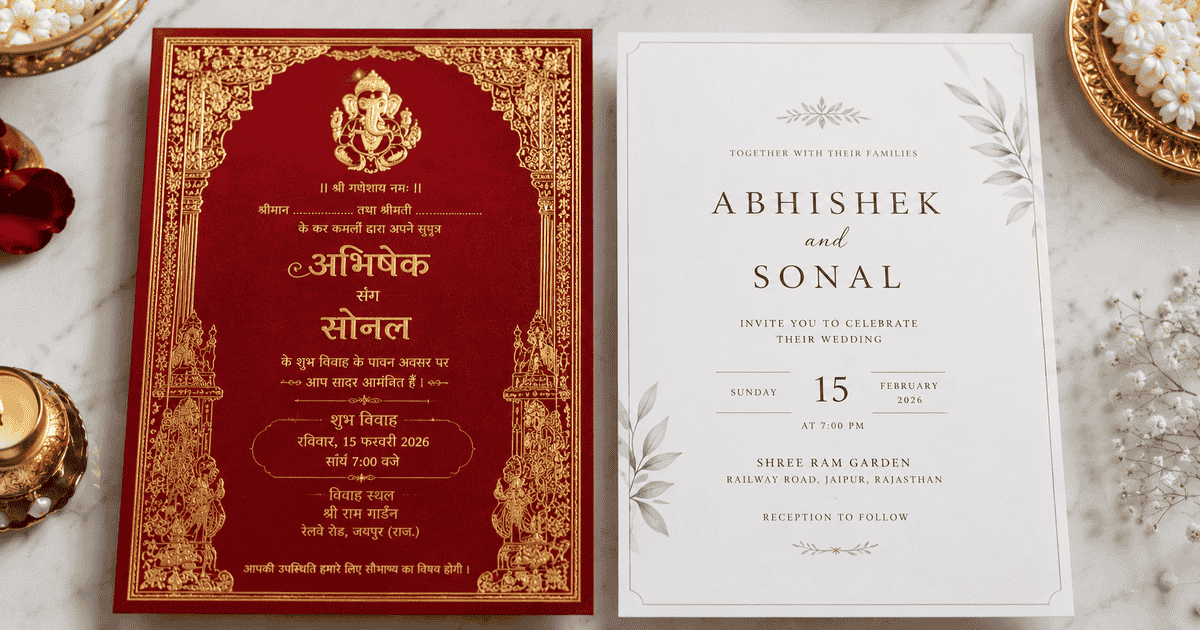
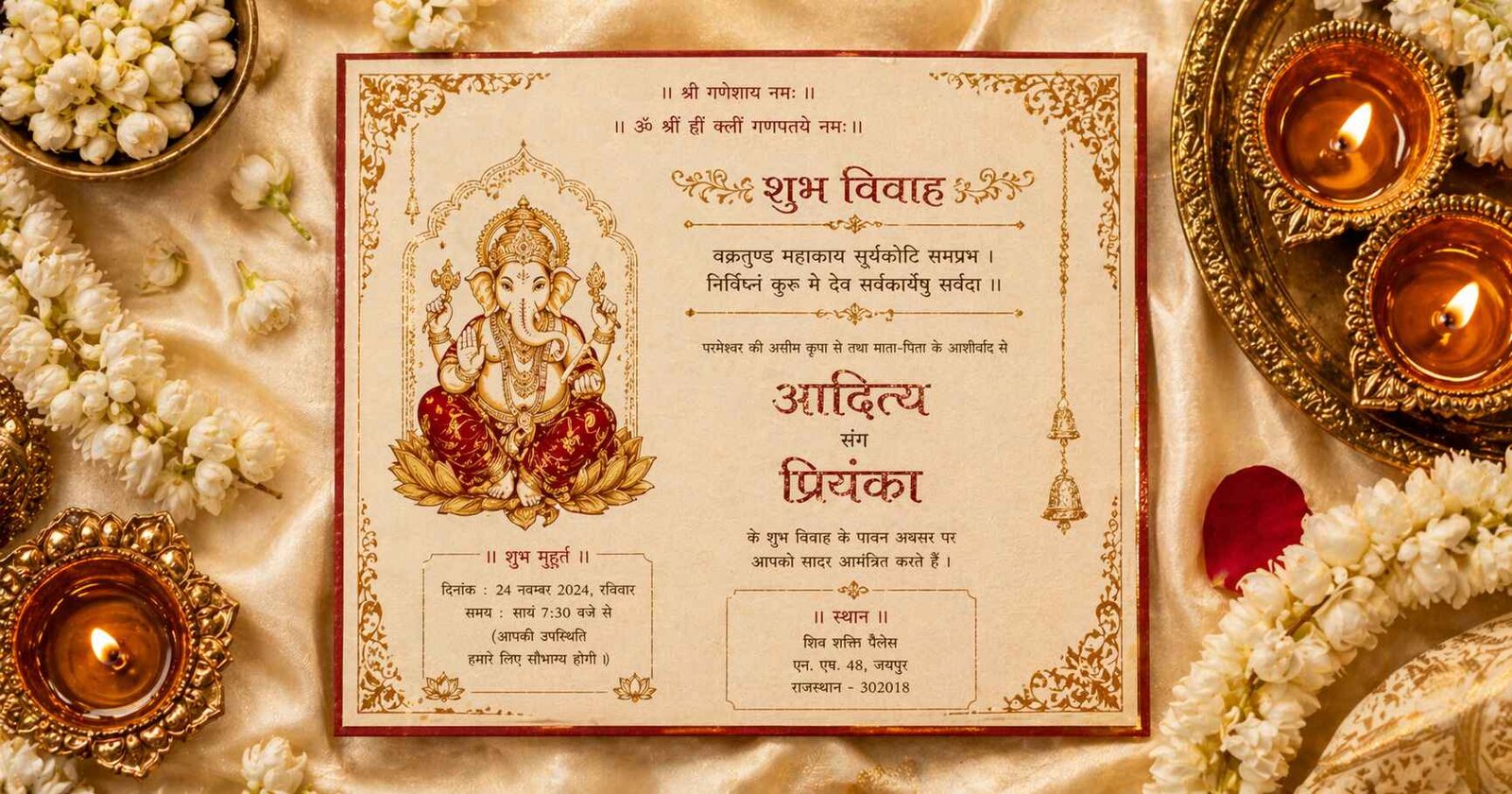
Shri Ganeshay Namah

With the blessings of the Almighty and our beloved elders,

Shri Ramesh Chandra Agarwal & Smt. Pushpa Agarwal
(Residents of Civil Lines, Allahabad)

joyfully invite you to the wedding of their beloved daughter
Example — South Indian Brahmin Format
Srimathe Ramanujaya Namaha

T. Krishnamurthy & Smt. Geetha Krishnamurthy
(Iyengar, Vadakalai, Vatsa Gotram)

request your gracious presence at the Vivaham of their daughter
South Indian invitations often include Gotram (clan lineage) and sub-sect details — this is important for Brahmin families.
Section 3 — Bride & Groom Details
List the bride first (as the card is traditionally from her family), then the groom with his parents' names.
Priya Agarwal
beloved daughter of Shri Ramesh Chandra Agarwal & Smt. Pushpa Agarwal

with

Ankit Sharma
beloved son of Shri Vijay Kumar Sharma & Smt. Sunita Sharma
(Residents of Model Town, Delhi)
Section 4 — Wedding Date, Muhurat & Venue
For Hindu weddings, the auspicious time (Shubh Muhurat) is extremely important and must be stated clearly.
Shubh Vivah

Date: Sunday, 22nd February 2026
Shubh Muhurat: 11:17 AM to 1:45 PM (as per Panchang)

Venue: Siddhi Vinayak Lawn & Banquet
123, Ring Road, Lucknow — 226001
Key Takeaway: Always state the Muhurat time separately from the guest arrival time. Many families write "Guests requested to be seated by 10:30 AM" to ensure ceremonies begin on schedule.
Section 5 — Sub-Event Schedule
Indian weddings span multiple days. A well-formatted card lists every function clearly:
Pre-Wedding Celebrations:

🌿 Haldi Ceremony
Thursday, 19th February 2026 | 10:00 AM
At Residence: 45, Nirala Nagar, Lucknow

💃 Mehendi & Sangeet
Friday, 20th February 2026 | 5:00 PM
Crystal Banquet Hall, Lucknow

💍 Wedding Ceremony
Sunday, 22nd February 2026 | Muhurat: 11:17 AM
Siddhi Vinayak Lawn, Lucknow

🎉 Reception
Sunday, 22nd February 2026 | 7:30 PM onwards
Same Venue
Complete Hindu Wedding Card Example
Example — Full North Indian Format
॥ श्री गणेशाय नमः ॥

With the blessings of God and our elders,

Shri Dinesh Kumar Verma & Smt. Kavita Verma
cordially invite you to the auspicious wedding ceremony of their daughter

Sakshi Verma

with

Abhishek Tiwari
son of Shri Suresh Prasad Tiwari & Smt. Rekha Tiwari

Shubh Muhurat: Sunday, 8th March 2026 | 12:30 PM to 2:15 PM
The Grand Palace Banquet, Kanpur

Mehendi: Friday, 6th March | 4:00 PM (At Residence)
Sangeet: Saturday, 7th March | 7:00 PM (The Grand Palace)
Reception: Sunday, 8th March | 8:00 PM onwards

For RSVP & directions:
📞 +91 98765 00001 (Dinesh Kumar Verma)
Regional Variations in Hindu Wedding Card Format
Gujarati Hindu Wedding Card
Gujarati invitations often begin with Jai Shri Krishna or Shri Ganapataye Namaha and may include the Gotra and village/native place of both families. The card also typically lists the Sagai (engagement) details if it is a recent event.
Bengali Hindu Wedding Card
Bengali cards often carry the invocation Shri Shri Durga Shahai at the top and are frequently bilingual (Bengali + English). The card lists the Ashtamangala ritual time separately from the main Saat Paak ceremony.
Marathi Hindu Wedding Card
Marathi weddings feature Mukhya Vivah Sohala as the heading for the ceremony and include the Nakshatra (birth star) of both bride and groom — important for matching. The card often starts with Shri Swami Samarth or Jai Jai Raghuveer Samarth.
Hindu Wedding Card Format for Digital Invitations
For WhatsApp and digital invites, adapt the format slightly:
- Keep the full structure but reduce the text density per section
- Use line breaks and emojis to separate sections visually
- Include a clickable Google Maps link for the venue
- Add an RSVP link or phone number at the end
Create Your Own Invitation in Minutes
Use einvits.com to design your Hindu wedding invitation with the correct format — pre-built templates for North Indian, South Indian, Gujarati, Bengali, and Marathi weddings. Personalise and share in minutes.
Get Started FreeFinal Thoughts
The Hindu wedding card format carries generations of tradition in every line. From the opening invocation to the Muhurat time and sub-event schedule, each element serves a purpose. Use the examples above to build an invitation that honours your family's heritage while making it easy for every guest — young or old, local or distant — to join in the celebration.