Biodata Writing Tips for Better Matrimony Matches — Expert Guide 2026
Most people write their marriage biodata once, share it everywhere, and wait. The problem is that most biodatas are written to describe a person — not to attract a compatible match. There's a critical difference. A well-written biodata doesn't just state facts; it communicates personality, creates connection, and filters out incompatible responses before the first phone call.
These expert biodata writing tips will help you create a marriage biodata that attracts genuinely better matches in 2026.
Tip 1 — Write an "About Me" That Actually Reveals You
The most common biodata failure is a generic "About Me" section:
- "I am a simple, family-oriented person."
- "I enjoy music, travelling, and cooking."
- "I am looking for a caring, loving partner."
These sentences describe almost every person in India. They say nothing distinctive. A better approach:
"I grew up in a traditional joint family in Lucknow but have spent the last five years
building my career in Bengaluru. I cook every Sunday (Dum Aloo is my speciality),
read one book a month, and take a solo trek every six months.
I believe that marriage works best when both partners feel genuinely free to be themselves.
I'm looking for someone who is warm, intellectually curious, and close to family —
because those three things describe me too."
This tells a story. It's specific. It creates a real sense of who the person is — and it naturally filters for compatibility.
Tip: Write your "About Me" as if you're describing yourself to a friend, not writing a job application. The goal is to attract the right person — not to impress everyone.
Tip 2 — State Your Income Clearly and Honestly
Income is one of the top compatibility factors in Indian matrimony. Avoid:
- "Good income" — means nothing
- "Confidential" — creates suspicion
- Overstating — will create problems when families meet and compare
State your income as an annual CTC range or take-home: "₹18 LPA CTC" or "₹1.2L/month take-home." Clarity builds trust.
Tip 3 — Be Specific in Partner Expectations — Without Being Rigid
Vague expectations attract incompatible responses. Overly specific ones scare away good matches. The sweet spot:
Too Vague: "Looking for a good, educated girl."
Too Rigid: "Must be from Allahabad, Brahmin, CA or Doctor, 5'4" to 5'6", fair complexion, non-Manglik, father must be in government service."
Just Right: "Prefer graduate or above, family-oriented, open to working or homemaker. Comfortable in Bengaluru or willing to relocate. Brahmin preferred but open to consideration for the right match."
Tip 4 — Include a Photo That Represents You Today
A 5-year-old photo from a wedding where you looked your absolute best creates expectations that are hard to meet in person. Use a current photo (within the last 12 months) in decent clothing with natural light. A genuine smile in a photo increases positive response rates significantly.
Tip 5 — Write Family Background With Warmth, Not Just Facts
Compare:
Dry: "Father: Retired. Mother: Homemaker. Sister: Married."
Warm: "Father retired after 35 years as a government engineer — now manages a small farm outside Lucknow that the whole family visits on weekends. Mother is a homemaker who is also a superb cook and runs the household with warmth and efficiency. Elder sister is married in Pune; we are very close."
Families reading biodatas are not just evaluating the candidate — they're evaluating whether they want their son or daughter to join this family. Warmth in the family description creates invitation, not just information.
Key Takeaway: The family background section of a biodata is often read by the girl's/boy's parents first — because they are assessing whether they want their child to become part of this family. Write it with the warmth and pride you genuinely feel about your family.
Tip 6 — Update Your Biodata Every 6 Months
Outdated biodatas create awkward situations. Update:
- Age (recalculate each year)
- Income (after every appraisal)
- Job title (after every promotion)
- City (if you've moved)
- Photo (every 12–18 months)
Tip 7 — Create Separate Versions for Different Contexts
- Traditional community version: Full format with Gotra, Nakshatra, religious invocation
- Online matrimonial platform version: Modern design, scannable, less personal detail upfront
- Progressive families version: Focus on career, personality, and values — lighter on astrological details
One biodata does not fit all contexts. Maintain two or three versions.
Tip 8 — Use a Dedicated Matrimony Email
Create a new Gmail specifically for matrimony correspondence: yourname.matrimony@gmail.com. Benefits:
- Keeps matrimony conversations organised and separate from work
- Can be given to parents to manage if needed
- Professional-looking for families who receive your biodata
Tip 9 — Avoid Negatives and Disclaimers
Every word on your biodata should be positive or neutral. Avoid:
- "Not willing to relocate" → Instead: "Preferred location: Bengaluru"
- "No dowry" → Simply omit this from the biodata; raise it when discussions progress
- "Previous proposals did not work out due to horoscope mismatch" → Never include this
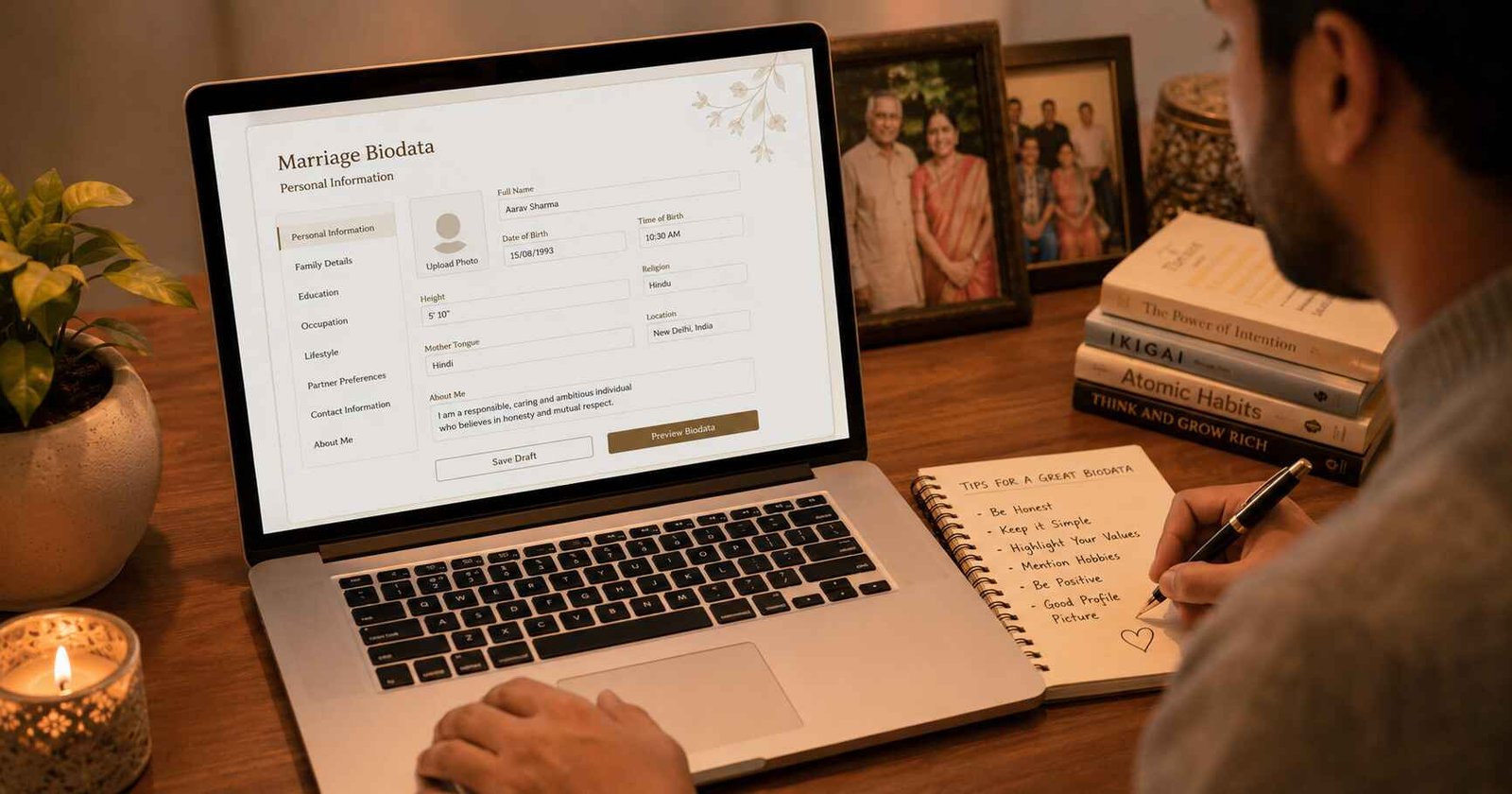
Tip 10 — Have a Parent or Trusted Elder Review It
Your parents will often catch things you've normalised: an out-of-date detail, a section that sounds presumptuous, an income figure that needs updating. A fresh pair of eyes — especially from someone in the older generation who knows the matrimonial context — adds enormous value.
Create Your Own Invitation in Minutes
Apply these tips and create a standout marriage biodata on einvits.com. Professional templates, easy customisation, and free PDF download. Make your biodata work as hard as you do.
Get Started FreeFinal Thoughts
A great marriage biodata is not written in 20 minutes on the first try. It's written thoughtfully, reviewed carefully, and updated regularly. It tells a true story about who you are, represents your family with warmth, and gives a compatible match every reason to say: "Let's find out more." Invest the time. The right match is worth it.