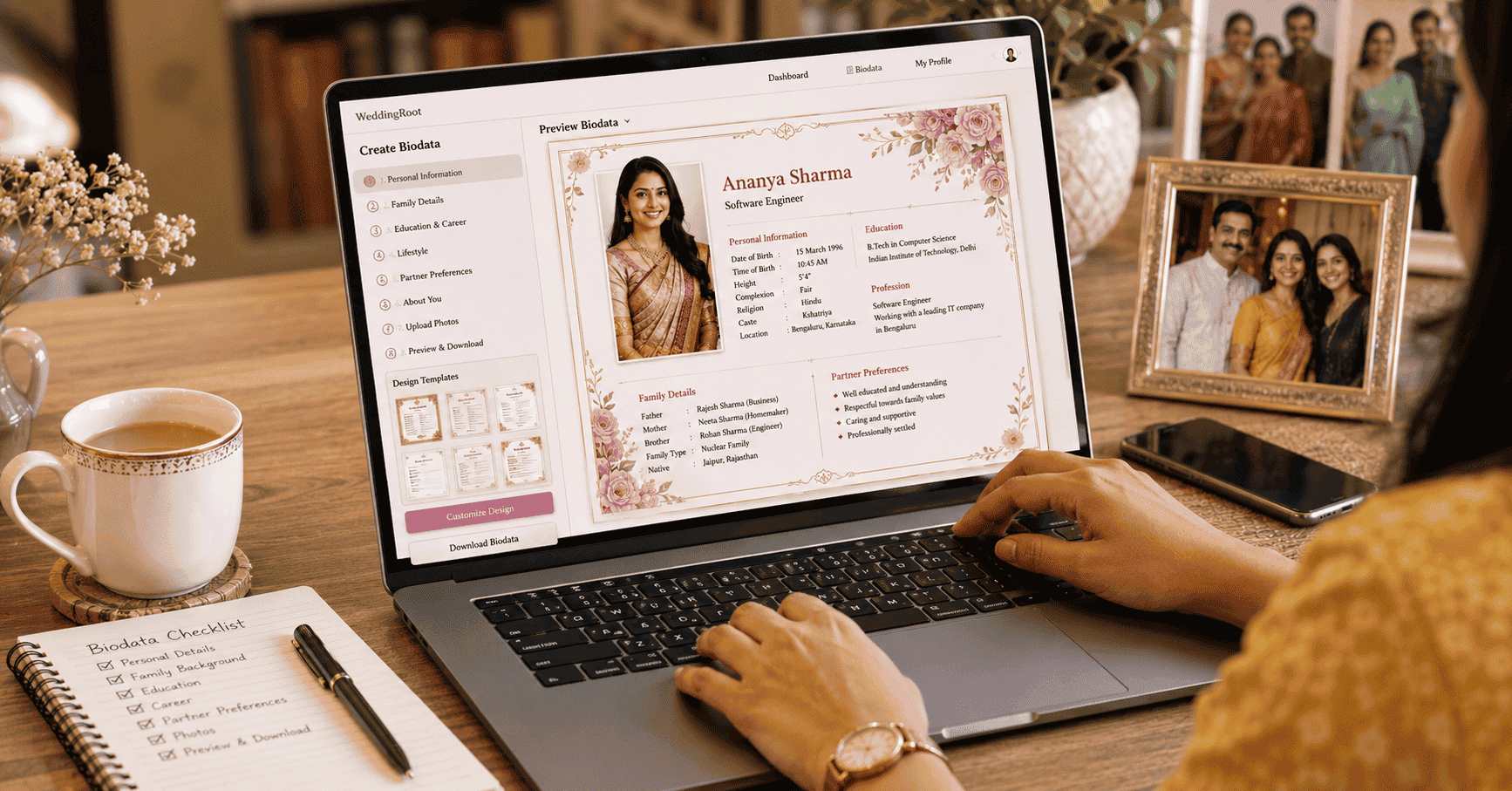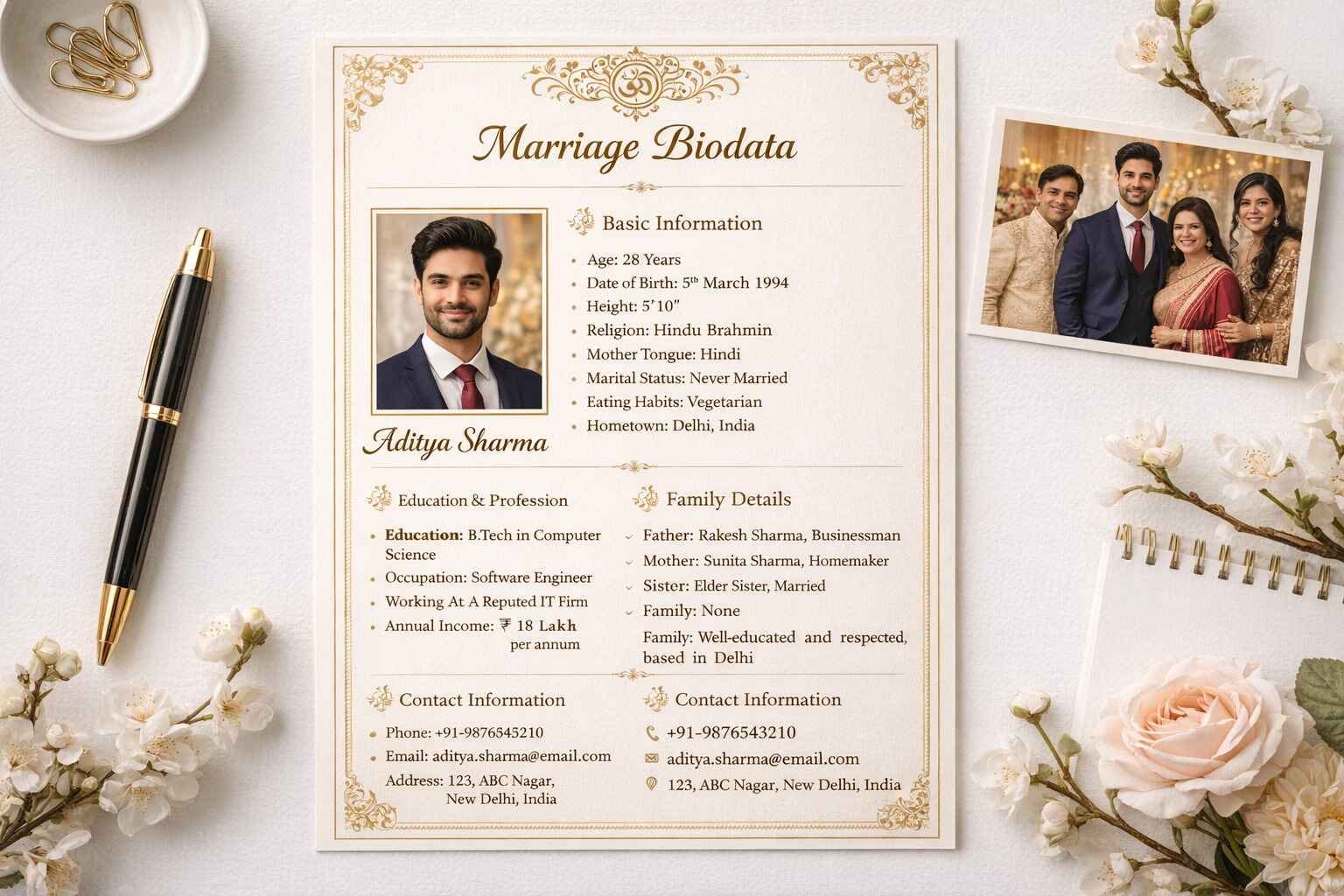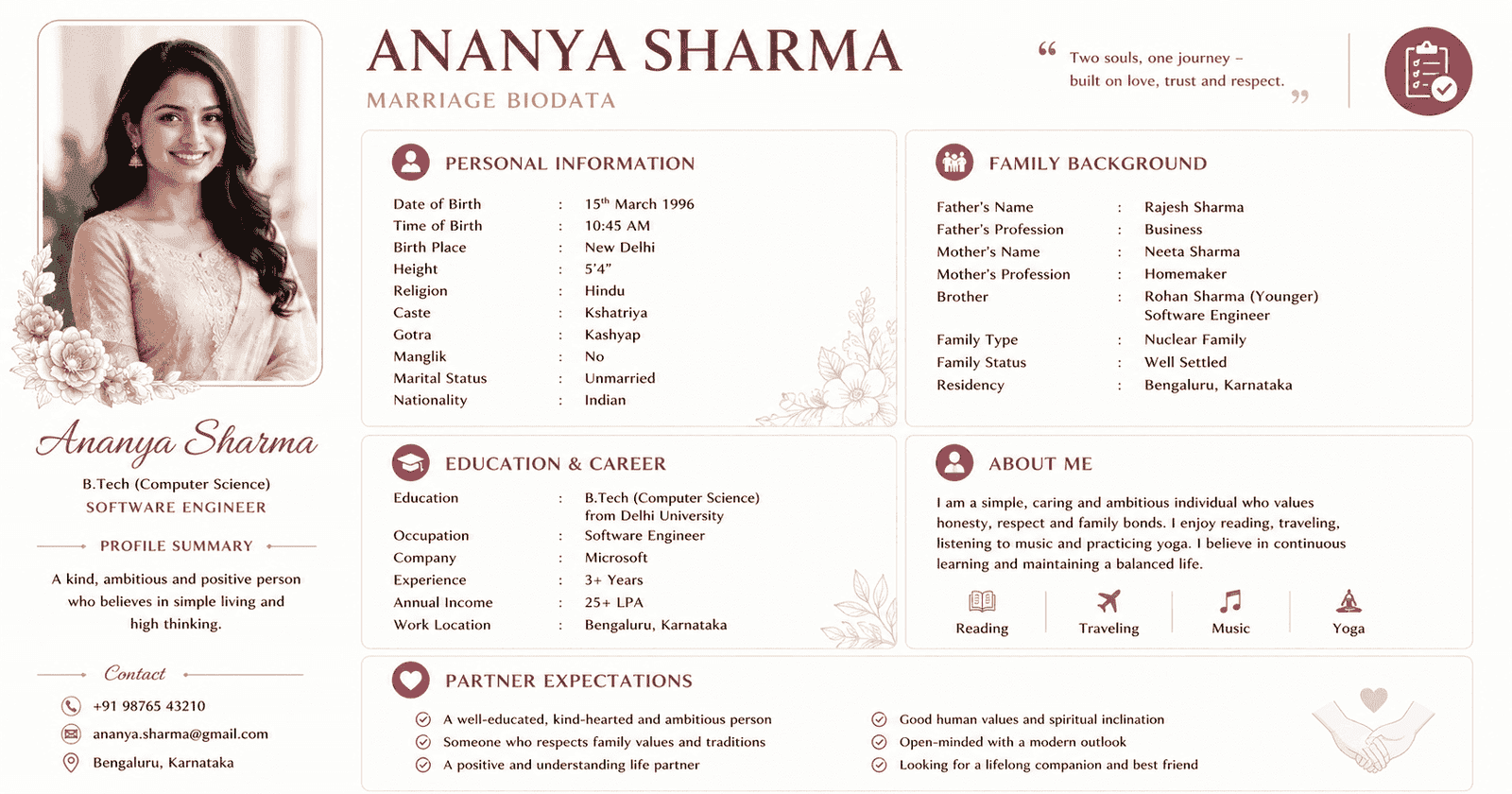
What to Include in Marriage Biodata — Complete Guide 2026
A marriage biodata is one of the most important documents you'll create in your matrimonial journey. Get it right and it opens doors to meaningful conversations. Get it wrong — by including too little, too much, or the wrong things — and it creates confusion or missed opportunities.
This guide tells you exactly what to include in your marriage biodata, section by section, with tips on what families actually look for and what you can safely leave out.
The 10 Essential Sections of a Marriage Biodata
1. Religious / Cultural Opening
Include it? Yes — for traditional Indian families, especially Hindu, Muslim, and Sikh.
A brief invocation at the top (Om, Bismillah, Waheguru) establishes religious identity immediately. For secular or intercommunity biodata, skip this or use a neutral opening like "With Blessings."
2. Personal Details
Include it? Always — this is the core of the biodata.
Must include:
- Full name
- Date of birth (with year)
- Age (state age clearly — don't make families calculate)
- Place of birth
- Mother tongue
- Religion
- Caste and sub-caste (for communities where this matters)
- Nationality
- Current city
- Marital status
Tip: Always include both date of birth AND age. Families often want to quickly check the age without calculating. Stating "Age: 28 years (as of 2026)" eliminates ambiguity.
3. Astrological Details (for Hindu Families)
Include it? Yes, if your community uses kundali matching.
Include:
- Rashi (Moon Sign)
- Nakshatra (Birth Star)
- Gotra
- Manglik / Non-Manglik status
- Time of birth (optional but useful for kundali matching)
Attach the full Janam Kundali as a separate document if the family requests it — don't crowd the main biodata page with complex astrological tables.
4. Physical Details
Include it? Yes — height is the most referenced physical detail in matrimony.
Include:
- Height
- Weight (optional but commonly included)
- Complexion (optional but often listed)
- Blood group (practically useful)
5. Educational Qualifications
Include it? Always — education is a top compatibility criterion.
Include:
- Highest qualification (degree name, institution, year)
- Additional certifications if relevant and impressive
- List in reverse chronological order (most recent first)
Key Takeaway: Don't list every school certificate from Class 10 onwards. Focus on your highest two or three qualifications. The degree and institution are what families care about — not the percentage unless it's exceptional.
6. Professional / Occupation Details
Include it? Always.
Include:
- Current job title / designation
- Company name
- City (if different from home city)
- Annual income (CTC or take-home — be clear which)
- For self-employed: business type and approximate annual turnover
7. Family Background
Include it? Always — family background is often the most important section for parents reviewing biodatas.
Include:
- Father's name and occupation
- Mother's name and occupation (or "Homemaker")
- Siblings — names, marital status, and occupation
- Family type (joint / nuclear)
- Native place / ancestral hometown
- Current city of family
Optional but appreciated:
- Whether parents are working or retired
- Family's general business or professional background ("business family," "service family")
8. About Me / Personal Statement
Include it? Yes — and write it carefully.
This is the most read and least written section. Write 4–6 honest sentences covering:
- Your personality and values
- What you enjoy outside work
- Your relationship with family
- What you're looking for in a partner
Avoid clichés: "I am a simple person" or "I love music and travelling" — these describe literally millions of people. Be specific to you.
9. Partner Expectations
Include it? Yes — it saves time for everyone.
Include:
- Preferred age range
- Educational preference
- Occupational preference (working / homemaker / open)
- Location preference (open to relocation or specific city)
- Caste/community preference (be honest — it's a filter, not a judgment)
- Any other important preferences
10. Contact Details
Include it? Always.
Include:
- Contact person name (self, father, or mother)
- Mobile number
- Email (create a dedicated matrimony email)
- City and state
What NOT to Include in a Marriage Biodata
- Negative history — failed engagements, previous rejections, health issues (unless material)
- Excessive restrictions in partner expectations — sounds inflexible
- Outdated photos or none at all — always include a recent photo
- Irrelevant school achievements from Class 10/12
- Social media handles — keep personal and matrimonial profiles separate
Create Your Own Invitation in Minutes
Create a beautifully designed marriage biodata on einvits.com — professional templates for boys and girls, easy to customise, free to download. Stand out in Indian matrimony with a biodata that makes the right impression.
Get Started FreeFinal Thoughts
A great marriage biodata is complete without being cluttered, honest without being over-sharing, and specific enough to attract the right matches while remaining open to genuine connection. Use this checklist every time you update your biodata, and ensure every section is current and accurate. Because the right match is out there — and your biodata is the first step toward finding them.