Indian Wedding Traditions Explained — Complete Guide to Rituals & Ceremonies 2026
An Indian wedding is not a single event — it is a series of deeply meaningful ceremonies, each with its own ritual significance, emotional weight, and cultural purpose. Understanding these traditions transforms the experience from a spectacular production to a profound journey.
This guide explains the major Indian wedding traditions — what they are, why they're performed, and how they vary across Hindu, Muslim, Sikh, and Christian communities.
Pre-Wedding Traditions
1. Roka / Sagai (Engagement / Alliance Formalisation)
Community: Hindu (North India)
Meaning: The first formal meeting of both families to "stop" the search for matches. The groom's family visits the bride's home with gifts, sweets, and a small ceremony to formalise the alliance.
Significance: From this point, both families consider the match confirmed. No further proposals are entertained.
2. Tilak / Sagai Ceremony
Community: Hindu (North India)
Meaning: The groom's forehead is marked with tilak (vermillion) by the bride's brother as a formal blessing and acceptance. Gifts are exchanged between families.
3. Mehendi Ceremony
Community: All Indian communities (universal)
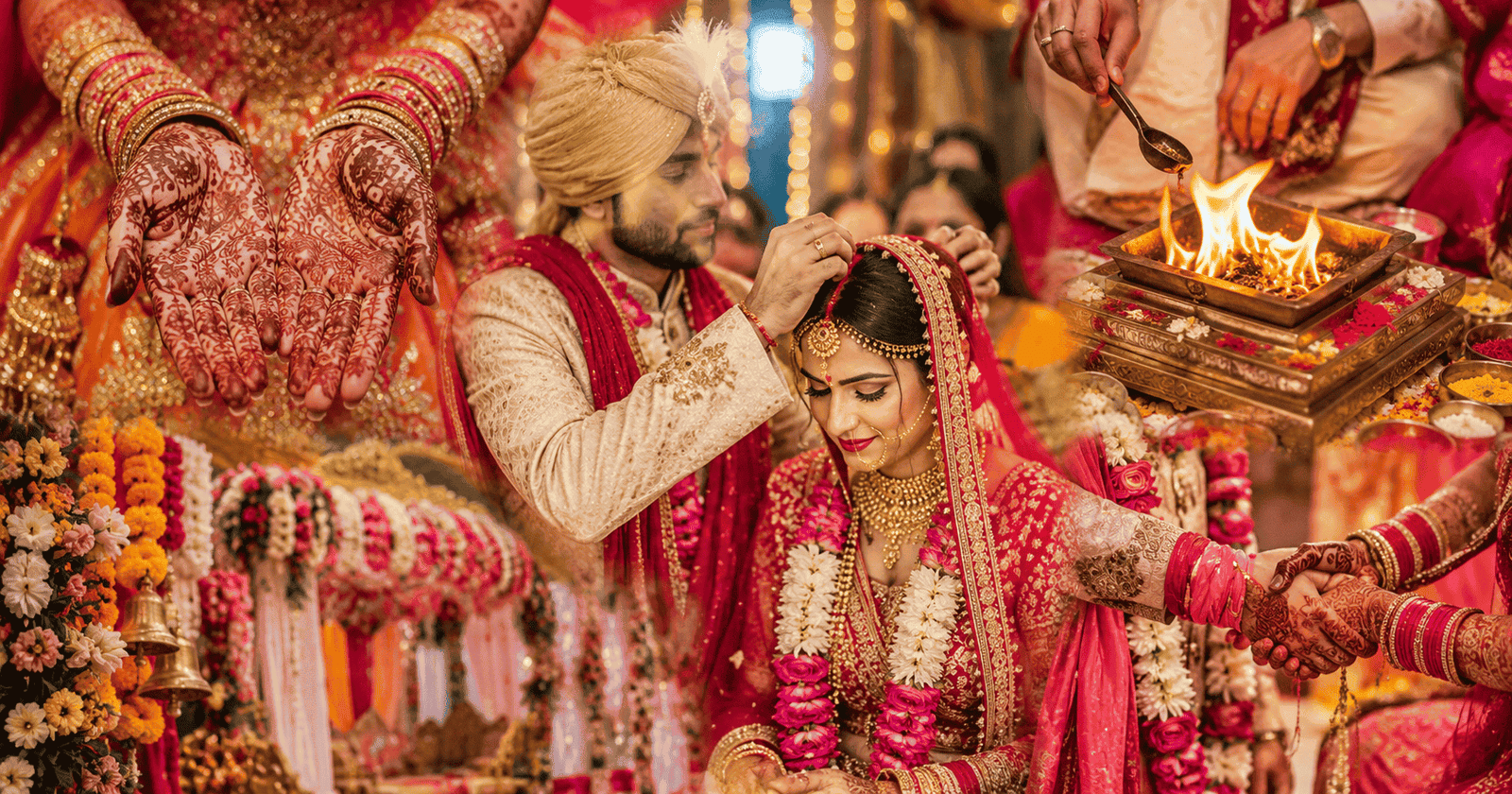
Meaning: Intricate henna designs are applied to the bride's hands and feet. The groom's and bride's names are traditionally hidden within the pattern — the groom must find them on the wedding night.
Significance: Mehendi symbolises joy, beauty, and the bond of marriage. The deeper the colour, the deeper the love — according to tradition.
Modern element: Mehendi night has evolved into a celebratory event for all female guests, with music and dancing.
4. Haldi (Pithi) Ceremony
Community: Hindu (all regions), sometimes Sikh
Meaning: A paste of turmeric, sandalwood, and rose water is applied to the bride's and groom's face and body by family members.
Significance: Turmeric purifies the skin and is considered auspicious. The ceremony also marks the bride's "withdrawal" from ordinary life before the wedding — she cannot leave the house after Haldi until the ceremony. The chaotic, playful nature of the Haldi has made it one of the most photographed events in modern Indian weddings.
5. Sangeet (Musical Evening)
Community: Hindu, Sikh (increasingly all communities)
Meaning: A celebratory evening where both families come together for music, dance performances, and celebration.
Significance: Originally the women of the household would sing traditional folk songs about the bride. Today it has evolved into a grand event with choreographed performances, live bands, and DJs — often the most anticipated pre-wedding event.
Key Insight: The Sangeet has become so elaborate that for many urban Indian weddings, it is more expensive to produce than the actual wedding ceremony. Professional choreographers are hired months in advance to prepare family dance performances. It is a full entertainment event.
Wedding Day Traditions (Hindu)
6. Var Mala / Jaimala (Garland Exchange)
Meaning: The bride and groom exchange flower garlands as a formal acceptance of each other. This is often accompanied by playful "lifting" of the groom by his brothers to prevent the bride from garlanding him easily.
7. Kanyadaan (Gifting of the Daughter)
Meaning: The most emotionally powerful moment in many Hindu weddings. The bride's father places her hand in the groom's and "gives" her to him — symbolically entrusting her wellbeing and happiness to her new family.
Significance: Considered one of the greatest gifts a parent can give. The moment is almost universally tearful.
8. Saptapadi / Phere (Seven Steps around the Sacred Fire)
Meaning: The bride and groom take seven steps around the sacred fire (Agni), with each step representing a vow — for nourishment, strength, prosperity, happiness, progeny, longevity, and friendship.
Significance: This is the legally and ritually binding moment of the Hindu marriage. The marriage is considered complete after the seventh step. The Agni (fire) is the divine witness to the vows.
9. Sindoor Daan (Application of Vermillion)
Meaning: The groom applies sindoor (vermillion powder) in the parting of the bride's hair — marking her as a married woman.
Significance: One of the most visually powerful symbols in Hindu marriage. The sindoor remains a daily symbol of marriage for many Hindu women.
10. Mangalsutra (Sacred Necklace)
Meaning: The groom ties a black-beaded gold necklace around the bride's neck.
Significance: The mangalsutra (literally "auspicious thread") symbolises the bond of marriage and is worn by Hindu wives as a daily symbol of their married status.
Post-Wedding Traditions
11. Vidaai (Farewell)
Meaning: The bride formally leaves her parents' home with her new husband. She throws puffed rice (laja) over her shoulders as she walks out — symbolically repaying her parents' gifts.
Significance: The Vidaai is universally emotional — the most tearful moment of any Indian wedding. It marks the bride's transition from her birth family to her marital family.
12. Griha Pravesh (Entry into New Home)
Meaning: The new bride enters her husband's home for the first time, greeted by her mother-in-law with an arti, and stepping into a plate of milk and vermillion to leave her footprints.
Significance: Her footprints entering the home symbolise that she brings Lakshmi (prosperity) into the household.
Muslim Wedding Traditions
Nikah
The formal Islamic marriage contract conducted in the presence of a qazi (Islamic judge), two witnesses, and the families. The bride's consent (qubool hai) and the groom's acceptance seal the marriage. The Mehr (bride gift) is specified and agreed upon.
Walima
The post-wedding feast hosted by the groom's family — a Sunnah (practice of the Prophet) that publicly announces the marriage and celebrates with the community.
Sikh Wedding Traditions
Anand Karaj
The Sikh marriage ceremony conducted at the Gurudwara. The couple circles the Guru Granth Sahib four times (Lavan) as the wedding hymns are sung. The ceremony is completed in the presence of the sangat (congregation).
Christian Wedding Traditions (India)
Holy Matrimony
Conducted in a church, the ceremony includes Scripture readings, vows, exchange of rings, and a blessing by the priest. In Kerala, the liturgy may be in Malayalam, Tamil, or Syriac (for ancient Orthodox churches).
Create Your Own Invitation in Minutes
Planning a traditional Indian wedding? Create a beautiful digital invitation that captures your ceremonies and traditions on einvits.com. Hindu, Muslim, Sikh, and Christian templates available. Free to get started.
Get Started FreeFinal Thoughts
Every ritual in an Indian wedding is a story — of love, family, faith, and belonging. When you understand what each tradition means, your wedding transforms from a series of events into a deeply intentional ceremony of connection. Whether you follow every ritual faithfully or adapt them to your own expression, the spirit behind these traditions is universal: to celebrate love with intention, community, and joy.